
Home
 JWatcher is a powerful tool for the quantitative analysis of behavior. It can be used to address any theoretical problem that requires a complex sequence of actions to be scored by a human observer. JWatcher is written in Java[TM] and is hence not dependent on a particular operating system. It will run on almost any microcomputer capable of providing a Java Virtual Machine[TM]. We have a number of versions that we distribute at this site.
•The legacy version (version 0.9) works on older systems (Macintosh OS-9 and Windows-98).
•Version 1.0 works well on Macintosh, Windows and Linux operating systems.
•JWatcher Video only works on Windows XP systems; we include it because if you can get it running, it has novel features.
•We also include the very outdated JWatcher-Palm, in case anyone still uses Palm OS [TM] devices. We have not developed a more modern tablet version.
JWatcher can be used simply as an event recorder which logs the time at which keys are pressed. It was designed primarily for focal sampling, in which a single subject is observed continuously. The real power of JWatcher is, however, in its analysis routines. These calculate time budgets and provide statistics about the duration of behavioral states and the intervals between them. Version 1.0 includes a number of additional algorithms that can be used to study sequences and study conditional behaviors (e.g., to study the frequency of or time allocated to walking while chewing gum), as well as algorithms to combine multiple results files and those to study inter- or intra-observer reliability .
We developed JWatcher because existing event-recording programs typically force the user to make a restrictive series of decisions before beginning to observe behavior. JWatcher imposes few such constraints. It is based on a “score once, analyze many times” philosophy that we have adopted in our studies of animal behavior. For instance, a single data file can be used to calculate time budgets over both short and long periods, or to track changes in different subsets of the behaviors seen. Each behavior can be analyzed both as an instantaneous event (measuring frequency) and as a state (measuring total duration). The logical relationships between behaviors can be edited in post-processing (i.e., a given behavioral state can be redefined as independent or as mutually exclusive with others). The number of states that can be tracked simultaneously is limited only by the number of alphanumeric keys available. Users may choose to exclude or ignore certain behaviors in analyses, and categories can be combined to generate behavioral codes that were not originally scored. Batch mode analyses allow efficient processing.
JWatcher was designed to be used in association with common word processing, spreadsheet, and graphics software. It produces simple output files that can readily be imported by such programs. We have concentrated on developing new scoring and analysis algorithms, rather than duplicating functions in existing software.
Manuals
Sinauer Associates published the complete JWatcher manual: Quantifying Behavior the JWatcher Way but this is now out of print (you can still find used copies). You can download a PDF of the book here. In addition, the book has educational exercises, walks users through output, and contains suggestions for how to quantify behavior. We also freely provide a basic manual for the 0.9 version (version 0.9 manual). We also provide the manual for the Palm version (JWatcher-Palm manual) should you still have Palm pilots! If you have questions while running JWatcher, consult the book, manual and the list of Frequently Asked Questions. You can download a version of JWatcher for either Mac or Windows, with or without a supporting Java environment. Unfortunately, we currently do not have the resources to provide complementary user support.
Supplementary Material for the book: Quantifying Behavior the JWatcher Way
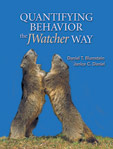 Videos and relevant files to accompany the book’s exercises can be found here.
Hardware and Software Requirements
JWatcher requires a Java Virtual Machine, which can be obtained as a free download (see below). Overall speed varies with CPU type and data analysis limits are dependent upon installed RAM.
For version 0.9, we suggest a minimum of 64Mb of free RAM and a Pentium II/III or G3/G4 >250mHz for running the whole package. We have developed and tested JWatcher using the Mac OS Runtime For Java version 2.2.3 which can be downloaded from Apple Computer’s site and the Windows Java Runtime Environment version 1.1.8 which can be downloaded from Sun Microsystem’s site. JWatcher 0.9 will not run properly with other versions of Java. It is possible to install Version 0.9 on newer machines and operating systems but you must associate it with the correct version JVM.
Version 1.0 runs under Mac OS-X (at least through 10.12 (Sierra), but it is not compatible with 10.3.9), Windows OS from XP through (at least) Windows 10, and Linux OS (thanks to Julien Martin for making the new builds).
Are you using Vista or Windows 7 or later? Some users have reported that the program ‘hangs’ on installation. Here’s a user-written trick to install on these platforms: Use JWatcher Version 1.0 and download the version with the JRE. Navigate to the installer that saved from the website. Right click on it and select Properties (should be the bottom option). In the window that opens, select the second tab (Compatibility). There is a Compatibility Mode listed on that tab near the top of the page. Check the “Run this program in compatibility mode for: ” checkbox. Select “Windows XP (Service Pack 2)” or “Windows XP Service Pack 3)”. Click the OK button in the bottom of the window. Run the installer.
Do you want to install JWatcher on a Windows 10 computer? Here are detailed instructions provided by a Katie McGhee (thanks Katie!).
A note about the (mostly inoperable) video version. Unless you’re running XP, you can’t use JW-Video. Users have reported more difficulties installing Version 1+Video. After ensuring that you’ve got all the ‘helper’ apps installed, here’s a user trick: At http://www.my-dll.com/index.php download the file called QTJava.dll Place the QTJava.dll file into C:\Program Files\JWatcher – Video V1.0\jre\bin (or wherever JWatcher Video is installed).JWatcher Video is particularly sensitive to updates in supporting software and security patches. Once running, we strongly suggest that you not update or modify software on that computer.
From a country where your decimal delimiter is a “,” not a “.”? JWatcher must force a dot delimiter for decimals when printing the results file so that it can be imported as a spreadsheet. If you’re using OS-X Mountain Lion,
change the ‘startjw’ file to read:
java -cp $CLASSPATH -Duser.language=en -Duser.region=US mq.psy.jwatch.admin.JWatchApp
This will force the use of a dot as decimal delimiter. Apparently, locale can also be set from within the Java environment.
JWatcher-Palm works with both Windows and Macintosh operating systems and on the Palm OS. It is difficult to install, and file transfer is somewhat clunky. Once running, it provides pocket-sized scoring functionality. If you need this functionality, you may find it very useful but we are unable to provide technical support. Follow the instructions carefully.
Download JWatcher Copyright (c) 2000-2020–Daniel T. Blumstein, Janice C. Daniel, and Christopher S. Evans†. All rights reserved.
JWatcher is a joint project of the following labs:
Dan Blumstein’s Lab University of California Los Angeles & the late Christopher Evans’ lab at Macquarie University, Sydney.
We thank the National Institute of Mental Health (1R21MH065226), The Australian Research Council, and Macquarie University for support.
Last modified: 11 July 20